
Navigating the Maker-Manager Schedule
How the cost of writing and cost of meetings are changing calendars

For anyone working in tech or creative industries, Paul Graham’s 2009 essay Maker’s Schedule, Manager’s Schedule has long been a standard mental model for how the days of creative individual contributors differ from those of bosses.
The principle is simple: Managers are effective when they spend time meeting other people. Makers are effective when they spend time mostly alone, producing outputs such as code or design. Product managers often struggle because they sit in the middle: they must spend time with people to make decisions, push forward proposals, and create buy-in. At the same time, they need time to think, write, and research.
AI tools complicate this further. Managers can now be makers, and makers can be managers. How does one scale as a manager in today’s environment? What does a typical calendar look like for someone overseeing 100+ people? I’ve battled this question over the summer and arrived at a few conclusions.
Writing is cheaper. Meetings are costlier.
Two shifts have changed how I view my time:
Talent is more senior and more capable than ever before. An intern can now craft reasonably well-written documents, and seniors can handle larger scopes as they become more efficient. Fewer people are handling larger scopes. The value and opportunity cost of each individual’s time has gone up.
It’s easier to write. LLMs help, but the real advances are in how fast and simple it is to produce text: Google Docs, Notion, Obsidian, Apple Notes, and others—combined with smarter keyboards, accurate dictation, and AI tools like Grammarly and Superhuman—make it much cheaper to write. The cost of writing is down, and quality is up (if tools are used well and as helpers, not as primary document generators; as of September 2025, AI tools still produce a lot of unsubstantiated fluff).
This pushes us closer to enforcing stricter guidelines for what meetings should be used for. Quoting Andy Grove (again):
Process-oriented meetings: to track status, updates, 1:1s, coaching. Keep these to a necessary minimum.
Mission-oriented meetings: to solve specific problems, solicit feedback, co-create, and make decisions.
The maker-manager’s schedule does not have standing meetings
The worst post-pandemic practice is the heavy use of standing, recurring meetings. These are usually “process-oriented” meetings. They’re often set up with comments like, “we can adjust the cadence as we go,” ignoring that cadence changes rarely happen because they carry friction: Can I cancel this meeting if not needed? Can I reduce cadence without offending someone? Would bi-monthly be more productive than bi-weekly?
Standing meetings are problematic: they’re often poorly prepared, lack clear outcomes, and fragment the day into useless chunks.
There are exceptions in my schedule. They may look like a lot, but here’s how they come together:
1:1s with direct reports and my manager (for me, 5 total meetings over 2 weeks). Weekly or bi-weekly, 30'-45 minutes each. No regular skip-levels; these happen as one-offs every few months. Cadence depends on trust with the report and the maturity of current priorities. I generally adjust every six months. Every two months, I’ll extend these to a career chat.
Staff meeting. Still debating, but keeping for now. Weekly with all direct reports, mainly for company updates, HR topics, and cross-department alignment. Ensures I see my team even when we don’t have 1:1s.
Cross-functional OKR review. With few standing meetings, great OKRs are my most valuable management tool. Reviewing progress and deciding next steps is often the highest-leverage meeting of my week. Bi-weekly, with only OKR owners and their peers.
Strategy Reviews via “office hours.” Two 45-minute weekly slots anyone in my department can sign up for and attend. Purpose: solve problems, get feedback, and keep leadership up to date.
Quarterly leadership cadences. Four times a year in preparation for the next quarter. These are justified because they shape great OKRs.
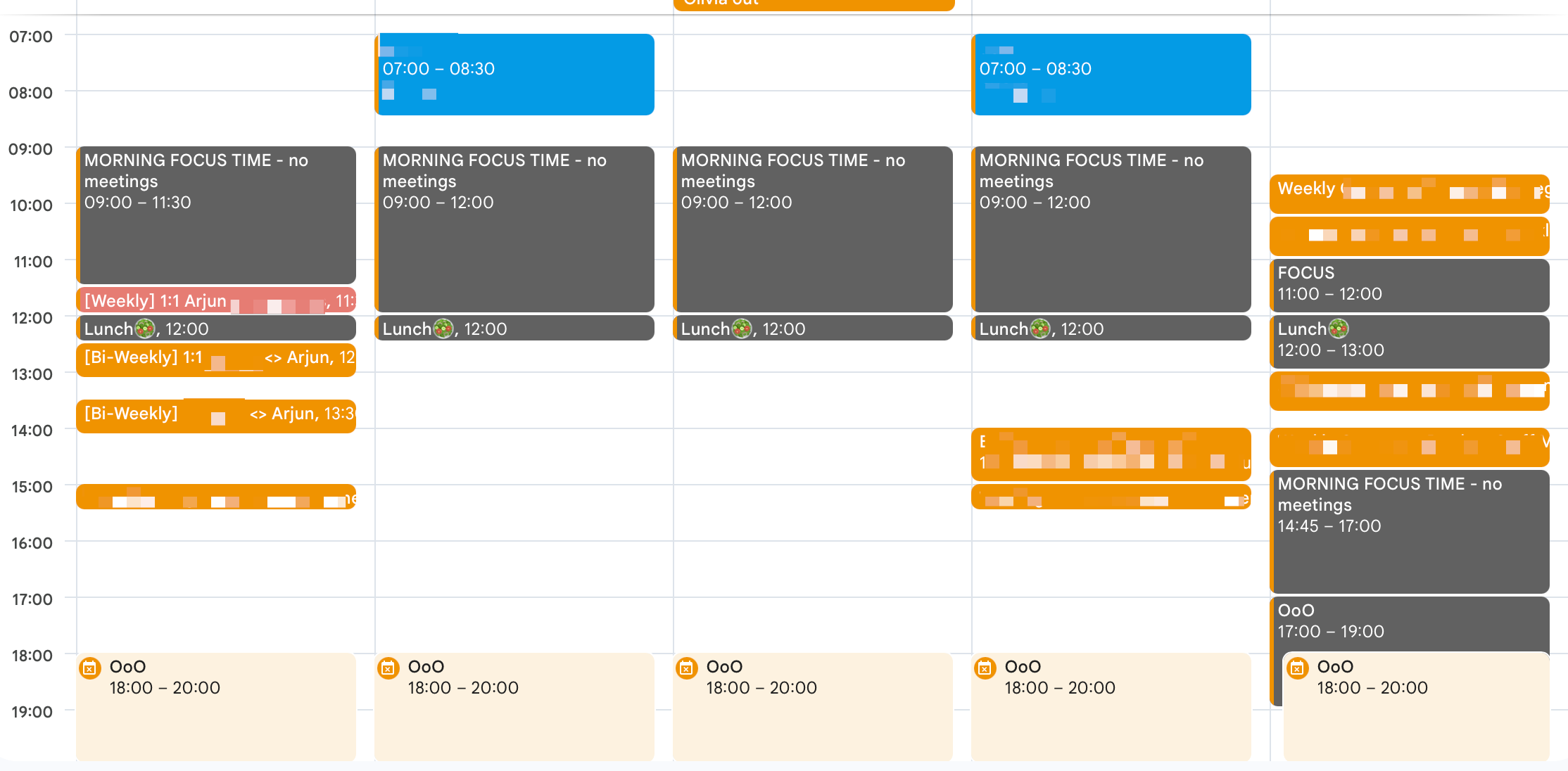
Here’s what a default week looks like for me these days:
Clearly, I get questions.
You have so much time! Look at all those free blocks?
The empty blocks fill up fast; there are weeks in my future that are already full to the brim. The image above is meant to show you the baseline of non-negotiable commitments.
How can you afford to have so many focus blocks?
The reality is that most of those focus blocks will get moved or broken up. The intention is to set a baseline to negotiate from. By default, I will defend those blocks as much as possible. Sometimes, they can’t be defended and there will be good enough reasons to violate those blocks. No week has passed without adjustments to those blocks. You can see such move on Friday, where the morning block was pushed to later in the day.
What do you do all day?
This is the deep fear of every middle-manager: If you aren’t “busy”, aren’t running from one meeting room to the next with your laptop balanced on a palm trying to see where the next meeting room is, what do you even do all day? I can tell you, I am definitely a very busy person. I just don’t need to make it a performance.
This gets to a deeper and more uncomfortable truth about managing high-leverage work. Three principles I’ll talk about in my next post will address this: Highlights, leverage, and stack ranks.